Wednesday, March 8, 2023

NPNM- Lost and found

There are certain moments in life when you lose yourself to emotions like anger, lust, etc., become something else for a while, and return to your true self when you regain your composure. You would look back in wonderment at what had taken you over, and how silly and foolish you had been to an emotion and losing your right senses. 

Nanpagal nerathu Mayakkam (NPNM) evokes a similar feeling, in a movie running for just under two hours and brilliantly stitched together with a series of absorbing visuals that look like water colour paintings of rural landscape of south Tamilnadu, memorably captured earlier in a series of paintings by Koilpitchai Prabhakar during the pandemic. 

Native series 2021 by Koilpitchai Prabhakar, accessed from his FB pg


The brilliant visuals int he film are topped up with a cacophony of songs and dialogues sound track from old Tamil films. It was a joy to watch the rural country, its people, their land and life presented with the masterful strokes of a very gifted artist.

It has been quite some time since a movie had me eating out of its hand, enjoying every morsel it had to offer thoroughly, and leaving me yearning for more- such was the quality of art that NPNM was. 
poster accessed from wiki


Every frame of the movie unfolds as a treat to the eyes, a stunning composition of colour and a brilliant experimentation with lighting. i have often gaped with wonder at the light blue tinge of the white that houses in south Tamilnadu are plastered with. It tends to have a cool chromatic effect in the summer and evokes a warmth in the rains. But to see this white plaster make a great canvas for the cinematograhy of this film was quite revealing.

Songs and dialogues from old Tamil films make the sound track of the movie. At times they sound perfectly in sync with the mood of the movie, and at other times they provide a jarring effect accentuating the pathos in the movie. These tracks though not placed randomly, act like abstract colours in a painting that can grow upon you the more you immerse in it. 'Vidu varai uravu' that plays out towards the climax sums it up best. 

The film has dusted and used props from the Tamil aural and visual treasures, stuff that has mostly been relegated to the cellar and safely ignored. The artist in the director has put these together and serenaded them in a carnivalesque delight, hoisting a mesmerizing spell on us with stuff from this Tamil cultural backyard. 

This movie seemed made for a very personal viewing experience, just made for a couch viewing experience in the comfort of your home. i am not sure how much would it have been enjoyed in a theatre. Many might find it slow and pointless.

For the first few minutes of the film, nothing much seems to be happening in the movie except for what looks like an impending accident that could crash on us anytime. But then the movie starts making you sit up when Mamooty stops the bus and gets off in the middle of nowhere in a rural Tamil countryside and starts walking out into the open, and then walks into a house and behaves as though the house and its people were his own. Suddenly the plot and its attendant intricacies reveal themselves in all their splendid possibilities and invites the viewer to immerse into a charming world of many splendors.

The screen play gently tickles moral judgements and slowly pushes the viewer into taking the side of one corner or other of the scale, and then springs a sweet surprise with an unexpectedly easy and neat resolution to undo the moral knot that it had us tied into. 

Mamooty revels in all the scope of acting this beautiful script provides. The bar scene invoking 'Gauravam' dialogue was one sequnce that brings the different glorious features of this film together- the acting, the paly with the lighting, the soundtrack of a classic film, and the immense potential for drama. 

However, the sequence that follows, in which a drunk Mamooty questions the people of his village could have been put together better. The making doesn't quite live up to the potential drama in that sequence.

The helpless, yearning blank stares of the two wives, the desperate friends of the families who want to force a return to normalcy, the blind mother sitting all day before the television immersing herself in all that the television has to offer (there by aiding in the playing out of the train of songs and dialogues) and playing an indifferent yet affective subject to the proceedings of the drama - are some of the lasting images from the film that are likely to stay with you for a long time. 

A very difficult truth, that could break one down, lands on a people unannounced and they are shown to be taking to it with a great heart and character. Its the beauty of these people and the character they show, that speaks of the immense nature of the human spirit, that makes this film all the more beautiful and absorbing. There are a few who happen to be small and react to it differently, but the Truth finally takes leave of these wonderful people with the soft treads of a dream, leaving these people smiling, with a little ache in their heart, at the  'அலகிலா விளையாட்டுகள் ', the crazy ways of the world.

Friday, December 30, 2022

அக்கினிக்குஞ்சிரண்டு ..


 அக்கினிக் குஞ்சொன்று கண்டேன் ..

தத்தரிகிட தத்தரிகிட தித்தோம்..


yes.. thats how i felt watching Apeksha perform on Meera's (K)Terrace. Meera's terrace offers an intimate space to experience dance on the same plane and from close quarters. 

I had watched Apeksha perform in Koham and she came in as a surprise package. After all, i was looking forward to Koham for Meera's (SN)performance, but here came someone matching and even bettering Meera. When i learnt later from a friend that she was only in her teens, i could not believe it.

 i was looking forward to seeing more performances by her. i got to see her off stage at BVB and  she looked like any languid bespectacled girl. But when she stepped into her BN costume and onstage to perform, she underwent a million transformation and appeared a veritable அக்கினிக்குஞ்சு.

her limbs seem to grow that extra length to make those hastas reach further, 
her fingers grown an in inch longer to make those mudras sharper, 
her torso grows a round sturdier,
she ages a little prettier,
her face glows like a lamp lit in the dark, 
her eyes speak a new language, 
and her tapping feet reverbrates across the floor
she swirls like the wind,
smiles like a lotus,
- she is a new avatar and a different force while performing.

Apeksha kamath has decided at an early stage to choose a life in dancing. it means a lot and shows her charecter and devotion, and having anchored in the shores of the magnanimous Indra Kadambi, she is bound to sail far and wide.

SaiBrindha follows closely on Apeksh's heels and has also anchored around this big tree of IK. SB is a tad simpler in comparision, and what she lacks in physical forcefulness she more than matches with her Intelligent applications. her mukha ahinaya stands out in her performance. Those little twists in the lips, cheek and eyes can hook any audience into the sway of her performance. 

SB will live with the fact  that she is always going to be compared to her peer in AK, she only has to remember that she has everything in her, and the gracious blessing of her guru, to match and win any competition.

Sandhya Udupa who started learning with IK as a young mother brought alive IK on stage in the 'little krishna' piece. IK's dedication and devotion seem to inspire the best out of her students and transforms  them into gold. 

Talking of the performances in the evening, i found it fascinating how the acharyas come alive through their choreography. Kalanidhi Narayan's choreography had the flair of a an instructive artist, while Leela Samson's choreo had some great agility, and Ik's choreo tended towards the experimental. 

my Salutations to guru IK for all the love and care she showers on her wards and for choosing to show case her student's talents in an unconventional space like Meera's terrace and hopefully setting off a trail blazer..

Monday, December 26, 2022

Performances @ Kalavahini

 Ever since I watched Meera and Sree perform a production specially made for a festival, i have been very excited about this idea and the initiative of Malavika Sarukkai and have been eagerly looking forward to the Kalavahini festival. It is heartening to see the the festival grow in brilliance and stature year on year. This year,i felt  the festival kind of reached its zenith with people starting to feel it a matter of pride to be showcased on this platform. The onus is now bigger on Malavika's shoulder to keep the spirit intact and soaring higher. 

The idea of identifying young talent and awarding a fellowship to them and helping them tend to a dance idea and see it grow into a production is fantastic and forms the core of this festival. This year we saw fellowship awardees Sarveshan ( jr category) and Sreelakshmi ( Senior cat.) present their works. 


Sarveshan had hit upon a gold mine in devi purana in the story of Kailasha Krishna. Just The brilliance of the idea was good enough to keep anyone hooked. The story is so rich in beautiful episodes each of which could be expanded into a full scale performance. Be it the imagery of Shiva and Parvathi captured in a moment of bliss, or the idea of Shiva desiring to take the woman's form to experience pleasure from the otherside of being a woman, any of them could form the seed of a full scale performance in itself. Sarveshan chose to expand on Parvathi's desire to be born as Krishna, in response to Shiva's desire. 

A lot of time, however, was lost in setting the context of the Kailasa and the ecstatic moment of the divine couple, and consequently, the expansion of Parvati's  desire seemed to have been rushed through. i wish Sarveshan  could give it more thought and application to expand on the latter part. Some liberties to go beyond the original could be taken to delineate each aspect of the desire.. for instance it occured to me that Parvathi could be said to desire the dark blue skin colour of Krishna, so that she could be constantly close to Neela kandan, she could be said to desire to grow in a yadava clan so that she would not be far from their vahana the rihaba, she could be said to appease Muruga by including a peacock feather on herself as Krishna...

Sarvehsan's training in Kalari showed in his performance. I also wonder if he has also trained in Kathakali, for the eyes were performing at an exuberant level. 

I had may be put too much expectations on Sreelakshmi's performance that i came out a bit disappointed. i felt she was trying to bring too many things into the performance and for me all of it didn't quite come together well. and it feels too preachy to talk about environment through dance. and too much gloom in a dance performance does not go well with me. the music and lighting for her work looked brilliant.

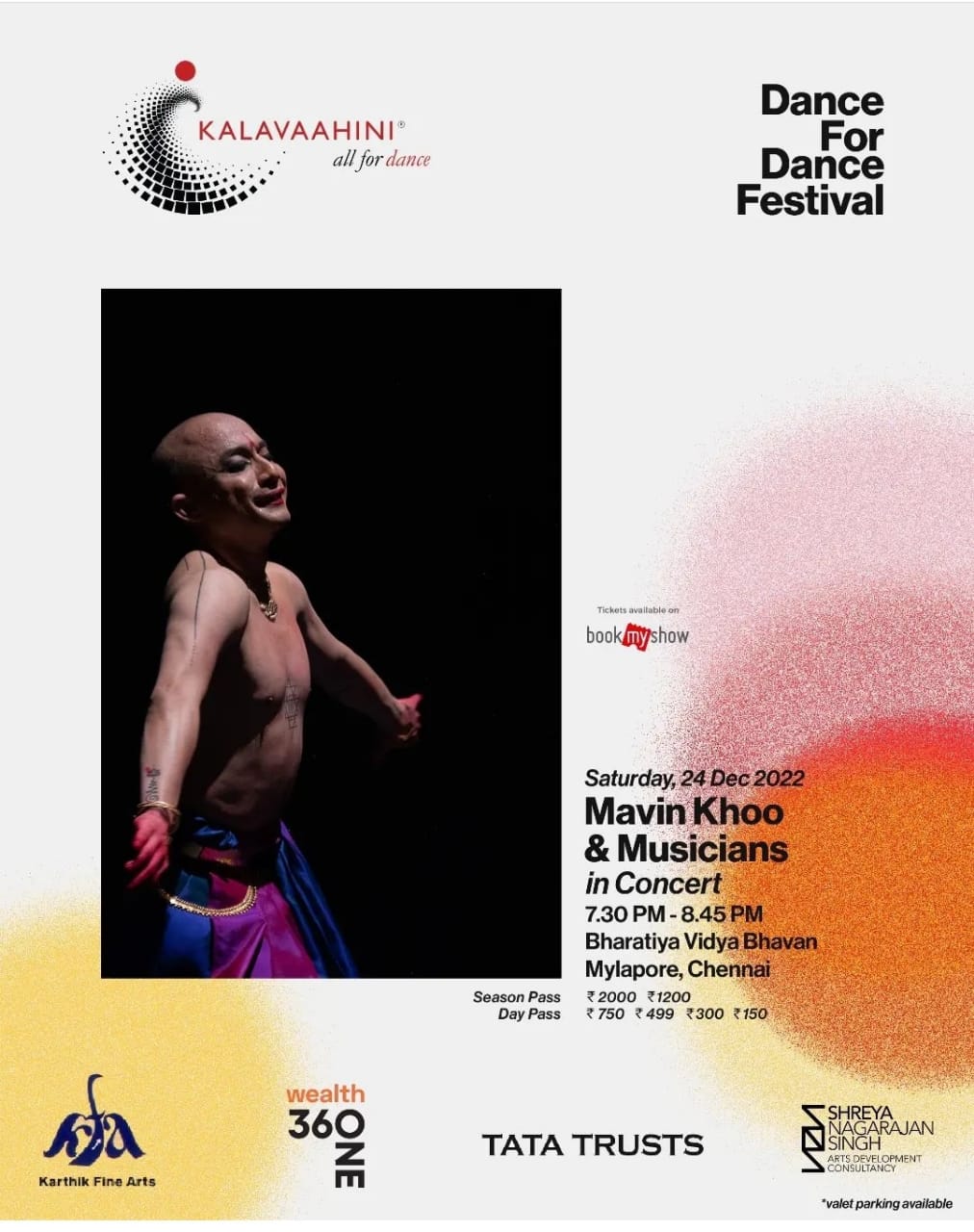
I was eagerly looking forward to watch Mavin Khoo perform- one because I had been hearing much about him and his name and foreign origin pinches ones curiosity. Mavin did not disappoint and i walked out of the show greatly satisfied. 

While watching the performance, i was keenly aware of myself constantly judging Mavin for what  he was doing on stage. Mavin can be difficult to absorb for some and can be too good to take your eyes off for others. what look like some of his antics on stage can be off putting for some. if one can get over this reservation and take it in as his characterization one is bound to enjoy his dance better. just during the course of this performance, my opinion often went to the verge dismissing his performance as just another comic stunt, when he would do something to suddenly overwhelm me and after a point i got completely absorbed, and sheer bliss afterwards, discovering layers of his personality and performance.


Watching Mavin, one felt BN had been cast into fresh new die. Every movement seemed to be fresh and different- he either manages to add a small physical twist to a regular movement or has created a entirely new visual vocabulary. While there were few moments when he reminded me of Bragah Bessel, otherwise he scripted something visually fresh and unique. We are probably witness to Mavin creating a Bani of his own.

There was a time when i suggested to a dancer that while dancing for 'karpuram naarumo, kamala poo narumo' it would pay to be meditating on the lips, rather than gesturing the camphor and the lotus. i think i saw Mavin performing at this level. He did not aspire to bring every syllable to abhinaya, instead he would just let his dancing body take in the lines and probably let his cells and muscles emote to those lines. 

There were times when you felt like watching John cage's 4'33''. Mavin constantly challenges the viewer to refresh his/ her visual cache.  Mavin has probably introduced 'vilambith or the 'super vilambith' in dance.

Mavin seemed to be taking the idea of slowing it down and then throttling it up suddenly to a new high and i think we are going to see many dancers take to this style at different scales. 

The idea of mixing 'Neerajakshi' and 'varuvaai ena' was brilliant and innovative. The vocalist fluently changed registers in setting the mood for the performance.

i wish Mavin had not ended the performance on a negative note, leaving the heroine still yearning for her lord. after showing a blissful ecstatic union earier on the middle of the piece, Mavin could have ended the performance with the heroine waking up to discover marks of the lord having visited her and left.

My respect, admiration and expectations off Karuna Sagari had gone notches higher after watching Tiruchendur at the NGS festival. at first she looked like a very small and different version of the splendor that she was while performing skandam. However she grew in stature over the course of the performance to reveal a new dimension. 

The Sundarar thevaram did not work for me, for one, it did not sound familiar to me, nor did it carry the trademark sweetness and other features we would expect of  a Sundarar thevaram. The segments where the lord and the goddess dance in alternation was brilliant. it would be interesting to see this segment as a duet.

while the varnam piece did not give much scope for making a difference, KS aced it all in the Nattrinai piece. her explanation for the piece was a brilliant performance in itself.

45. நெய்தல்
இவளே, கானல் நண்ணிய காமர் சிறுகுடி,
நீல் நிறப் பெருங் கடல் கலங்க உள்புக்கு
மீன் எறி பரதவர் மகளே; நீயே,
நெடுங் கொடி நுடங்கும் நியம மூதூர்க்

கடுந் தேர்ச் செல்வன் காதல் மகனே:
நிணச் சுறா அறுத்த உணக்கல் வேண்டி,
இனப் புள் ஓப்பும் எமக்கு நலன் எவனோ?
புலவு நாறுதும்; செல நின்றீமோ!
பெரு நீர் விளையுள் எம் சிறு நல் வாழ்க்கை

நும்மொடு புரைவதோ அன்றே;
எம்மனோரில் செம்மலும் உடைத்தே!
(குறை வேண்டிய தலைவனைத்தோழி சேட்படுத்தது)

KS expounded upon this poem in a brief introduction that was very foreceful and amply set the tempo for an even more power packed performance

Just the choice to perform this song was very powerful, as it demonstrates the power and strength of a woman to say no to a man and does so with great clarity and forthrightness. And this coming from a tamil woman from two thousand years ago, should be inspiring to girls of today. I am thinking of how this piece worked for me , while Sreelakshmi's , again a socially conscious and responsible piece, sounded preachy to me.

KS signed off her performance in a magical pose of a soaring swan, beautifully augmented by the soaring voice of Subhiksha and the blue lighting.

i had first come across Girish Karnad's Naga mandala as a play staged at the theru k koothu festival 2022 at Purisai, superbly performed by Kumaraguru drama troupe, ably directed by Arivazhagan. 

accessed from fb post of Gurusaravanan Manoharan

I would never have imagined that it could be made into a dance performance. Punyah dance company simply aced it and made delectable feast of dance, music and design. at times they had the audience peck out of their hands, they carried the script with so much grace and elan and topped it up with their individual brilliance to give us a scintillating premiere of their production. 


It was fascinating to see how much talent and effort had gone into the aspects of music, lyrics, light design and kudos to Parshwanath for bringing all these talents together . Their decision to do away with dialogues and convey the story line only through gestures was brilliant. The idea of dancers flipping between being the story tellers and charectars made for an interesting watch.

A fleeting moment when Parshwanath turned to the audience and egged the few spontaneous clappers to join in was magical. it was a string of moments like these, where the rasa built up in the audience and the bhava on the stage matched and resonated that made this production spectacular.

  I only wished i could understand the Kannada lyrics, for it could have greatly enriched the experience of the production. 

Congratulations to team Kalavahini for a great show this year. 

images except where mentioned accessed from Kalavahini's insta page 

Tiruchendur by Karuna Sagari

(the post had been lying a draft since Aug 2022

As a part of the annual Natyarangam festival of NGS, this year around the theme of Utsava Bharatham, each day saw the staging of a dance production based on the theme of the prominent festival in a Temple town. I got around to watching performance of the festivities in Madurai by Roja kannan and Priya Murle. and when i noticed Karuna Sagari was to perform a couple of days later, i told myself that i should not miss it. I have seen her perform and talk about dance and she showed she could be different, daring and innovative. once i saw her perform on a modest stage on a simple street, to a lay audience in the neighborhood where she probably lived. and in every piece she performed on that simple stage she was giving it her best efforts. this showed me here was someone made of steely resolve and soaring spirits.

Karuna Sagari was chosen to perform the festivals and story of Thiruchendur. The problem with performing divine stories is that most performers tend to aspire to keep their audience in a constant state of exaltation. one could achieve this by having the other dancers on stage go into an exalted frenzy whenever the divinity appeared on stage and thereby hoping to evoke the same in the audience- this would in turn constrain the scope of the choreographer and performer to produce anything new on stage. they would have to constantly fall back in to this trap loosing out on the innovative elements they could have otherwise explored.

i felt Roja Kannan and company fell into this trap. but they had elements of surprise in their performance that kept their production from falling flat into staging the divinity alone. the folk elements in their production were the most scintillating part of their performance. the production progressed by projecting the tales around the divine forms, tales of divine interventions, and the vehicles featured on each day of the festival. the role of sutradhari played by Sasirekha anchored the performance cogently and paved the way for the stories to bloom one after the other. the folk/pop tone in her delivery helped the audience lighten up and anticipate the next sequence. 


But I should confess Sasirekha’s performance was only half as good as the magic she could perform in ‘ Mylai kuravanji’ dance drama that most players of this ensemble had performed a few years ago. 

a couple of folk numbers in the sequence, namely on the festival day of Kuthirai vaganam and another a kavadi chinthu number brought a much needed difference to this performance. 

The dance sequence featured on the Bootha vahanam day featuring only the male dancers was a riveting bit of performance- some steps in the sequence reminded me of Padmasubramniam school’s signature styles, and those movements seemed to sit more adeptly on the male body. There was much to work upon in every sequence, and that some fine tuning – a little less of divine exaltation and little more of the folk elements- could have improved the overall experience of Madurai.


Moving on to Thiruchendur, Karuna Sagari lead her group of dancers with great spirit and energy. it was refreshing to see her perform as one of the Asuras and not as Muruga. And during certain group configurations on stage, she was graceful to be performing on the sides at times.

@ karunav insta page

Almost more than half of the performance was around battle scenes and it was a challenge to see how one could spice it up to make it interesting. And Karuna Sagari has cracked this puzzle and she has done it in style by bringing a difference with the choreography and a zing with some experimental music.

The battle scenes were choreographed with great rigor and energy, bringing in elements of Kalari and all the performers showed great intensity in these sequences, showing signs of some immersive training in the same. Some innovative deployment of music also helped carry the show further to greater heights.

The music was a big surprise element for the performance. The dynamic voice of Susha could be equally brilliant while bringing alive the divinity through Arunagirinathar’s lines and also when she set the stage and our hearts ablaze with a light rendition of ‘ aa aaa’ for the Krauncha giri sequence.

I was listening to her for the first time and the ease with which she rendered Arunagirnathar’s lines made me look up for the vocalist, and while at it she could shift gears with ease and change to another tempo and mood and carry on with great elan. The music of the quartet led by Priya and vocal support from helped add more punch to the performance.

It was quite revealing that KS could work on this idea for a long time, thanks to the pandemic, and she could bring in help and expertise from various corners. The use of compositions by her grandmother in the performance added so much more value to the overall experience of Tiruchendur. After all, there is nothing that can get better than a god that one can call one’s own, and a divine experience that gets more personal.

Inspired by the spectacle that KS’ show was, and the expectations of a rich Dussera celebrations at Mysore, I took my family along to see Pavitra Bhatt perform on the concluding day. We ended up  being very disappointed. The Only saving grace for me was to witness  and awe at PB’s stamina and endurance in performing long duration pieces.

PB had structured the performance around little snapshots from the dussera celebration and elaborating on them in detail. The choice of the snap shots was not eclectic and this led to show falling flat and unimpressive. The hall seemed to be filled with his fans and the big applause for small gestures from PB, making me wonder what was I missing out on.


Tuesday, June 22, 2021

learning with a humane artist..

it has been a month since my last post about my first exercise and i have in the mean time had my first brush with the various aspects of film making over fiver weekends, thanks to Ramani's course. This was such a cool course in its structure and execution, every wwekend we had 8 sessions, 4 with Ramani reviewing our exercises and 4 with experts who shared their knowledge. there was no compulsion to attend all the sessions and these were so good that you felt bad if u missed one. i am really glad i signed up for it.

as a part of the course i have had the oppurtunity to listen to some very fine film makers talk about their art and craft. i picked a few nuances on film appreciation and the great amount of thinking that goes into the making of every shot. i also enjoyed watching the works and development of peers from the course and listening to their perspectives.

The level of openness in the course was liberating and the gentle goading to complete exercises was motivating. It was rewarding to listen to Ramani and fellow course takers view and discuss one's exercises. These review sessions though they seemed to be a lot of drudgery, were quite enjoyable in that they were samples of work in progress. We had the option to skip these sessions, it was more exciting when your work or someone familiar's work was being discussed. But Ramani had to sit through all our exercises and discussions. it was quite a revelation to see Ramani watch every exercise with the same intent, sense of excitement and interest, and invariably pat with a , 'hmmm.. nice.. ', at the end of any work, before going into discussing different aspects of the work and inviting others to pitch in with their views.

In the first session of the course we got to listen to Biswajit Das, an animation film maker. Biswajit had recently converted to film making from abstract painting and during the lockdown he had kept himself motivated and charged to produce 100 animations videos over 100 days. he introduced editing tools and made editing and video making look very simple. 

In an another interesting session, listening to Narayanan talk, opened up so much to read into Ghatak's film Subarnareka. One particular haunting scene of a demon like character frieghtening child Sita, just as she is shown walking across a crack running across the dry landscape, suddenly made so much sense when he mentioned an allusion to Ramayana, and hintng upon  Ghatak's involvement in street theatre and art before coming to films. All these put together suddenly made the film so much more beautiful and meaningful. 


In another memorable session of the course,we had a chance to listen to Prateek Vats talk about his films Eeb Allay Ooo and A very old man with enormous wings. After watching a short video on the FTII Row, i expected to see a firebrand youth activist in Prateek, but we got to hear a very cool and composed professional speaking eloquently about his craft and attitude to film making.

A couple of disturbing scenes in 'very old man' and the way Prateek talked about filming it and framing it and putting them in a perspective spoke a lot about the depth of his philosophy, passion and honesty. The way he explained nuances that went into the making of select scenes from eeb allay ooo revealed his solid technical clarity and the openness to share it with us was humbling. 


Ramani's closing session for the course was an immersive session on his journey in film making and a peek into his filmography. The session brought to fore the ever experimenting artist in Ramani and the amorphous character of his films. the session glided on for 5 hours and no one was in a mood to leave and finally Ramani had to take the call to close the session filled with emotions.

the course was also a great oppurtunity to relish and learn from films made by course mates and drawing inspiration from their works and experiences. this was the fifth batch for Ramani since the lock down and he is as excited as ever.


Friday, May 21, 2021

First swipe at Film making


I just registered for a film making course with Ramani and he has already brought  a difference to my life. I have shot my first ‘Video’,  thanks to the first Exercise in Ramani’s film making course.  At first I thought it strange of Ramani to dispatch an exercise even before the course had started.

But Ramani’s description of a Shot and the things that he looks for in it got me hooked. The fact that he said shots reflected attitude, ruled out any casual attempts. I had to put some effort to make a good submission. I was jogging my brain for different concepts/ ideas I could work on. Even though we were in a lock down, I did not like the idea of domestic scenes.

The conversation/ encounter I had the previous day with a woman who was selling palm fruits, inside a farm, appeared to be a good premise to capture on video. But this would require going back to her, convincing her and repeating a conversation- at the loss of natural behaviour. But it was still worth trying, I thought. I was thinking in terms of possible angles, dialogues and scenes to include in the video. Viola!! This felt so different to me. I was venturing new territory. I was learning a new language, a craft.

But then I did not want to wait till going out to the farm and wanted to have a couple of back up videos, as time was short and the deadline was drawing closer. So in a moment of intrepidity, I took my phone and stepped out of the house. It felt very different. I was trying to script a video out of thin air. And there were so many stories happening around me.

A bunch of goats grazing around offered themselves for a shot, I tried my camera on them, but then it felt stupid not to capture the flight that was passing by making all that noise that registered itself in the goat video. A second shot that I tried centering on the kolam in front of our house and capturing the legs of the goats as they walked on it, was good , but fell sadly short of capturing one mischievous goat that was eyeing the open gate and trying to enter the house. The video didn’t feel complete without capturing this mischief.

Then I thought of a concept around ‘flying’- capturing bees, butterflies, crows, and finally a flag. I had also conceived a poem a to go with this video.

Flying

The flight of the bees feels like music

The flight of the crow feels like an escapade

The flight of the myna feels like fresh rain drops

The flying of a flag…?


The video did not work because the actors failed to turn up just in time.. Finally, a video of two goats answering each other’s calls and in the end, walking together felt good. It had everything I was looking for - an idea, concept, actors, sound and all- falling in place. It was worth submitting for the course.  

I am glad that this simple exercise has done profound things to me. I have had an opportunity to experience what it feels like to conceive and create something. I have now had a swipe at being an artist. I had conceived a poem after such a long time. I was now looking at the movies on my TV in terms of the shots that they had been conceived and found a lot more to appreciate in a movie. That’s a whole new world opening up before me. Thanks to Ramani’s first exercise..

Tuesday, May 12, 2020

Flying over Maddy Land

I First met Madhavan Palanisamy and his works in a show that was a part of CPB 2016. The show was called 'in dreams.'. I remember the show for the shock i felt when i encountered the image of beloved writer Kovai Gnani in one of the pictures. i was shocked at the treatment of a father figure and his blindness. i went back to the artist's bio note to gather more information about the artist, and it was a surprise to discover that Maddy was the son of Kovai Gnani. i was also glad to have Maddy around and talk to him about the shock and get over it.

After i got talking to Maddy about the show, i started making sense of his other works, but the portrayal of the father figure was still unpalatable for me. After all these years, i got an opportunity to listen to Maddy again, and this time talking about the entire gamut of his photographic, personal and professional journey on a platform made possible by Thalam. This was a good opportunity for me to understand and appreciate Maddy's works in their entirety over a span of a couple of decades. 

At this juncture, i should thank Thalam for providing an opportunity to listen to and have a glimpse of a lifetime's work of so many photographers. This has come as a boon during this lock down period to understand, appreciate and engage with so many different professional paractices, journeys and aspirations. 

Maddy's upbringing as the youngest child in a doting home, where he was 12 years younger to his elder brother; His scholarly father's doting on him and taking him along to watch avantgarde European movies, and sowing in him a sense of freedom in his thinking and sensibilities all show in different aspects of Maddy's body of works. Maddy seems to savour a childish enquiry and treatment of the world around him. This is most evident in the occasional graphic story board that features in his works.

These graphic illustrations are at once playful and profound in their minimalism. Maddy arrives at photography after dabbling with a career in Pharma and Management. He presented an overview of his works done under commission and of his personal experiments with photography. I have engaged mostly with the non commissioned body of work, though i have occasionally drawn from the commissioned work only to illustrate my view point. In my reading, there are two things that run common through Maddy's body of works - sensuality and playfulness.

Maddy creates an aura of sensuality in his images by playing with the lighting of the face. The sensuality in his images are deeply embedded and coded in the lighting and positioning. A woman's toe placed tenuously on a man's head was the hieght of sensuality in his images for me. But here Maddy plays around with the viewer's perception by not giving the viewer anything away to guess that it is a woman's foot, and further places the image in the middle of a deep cosmos like ambience and evokes the images of a primordial Shiva and Shakthi. 

One also wonders if it is the light that Maddy fancies and fetishizes. This is more so evident in his work built around his visit to America. He is fascinated by the different quality of the light in that part of the world and produces and dreamy body of images, where building facades look like fabric and landscapes carry an European film montage like quality. 

Maddy's playfulness is what is amply evident in most of his work. he does this by introducing Graffiti and toys into his work. 

He introduces another layer of playfulness by knocking down the legs of science and the laws of ordinary perception and throwing an unhinged image at the viewer and inviting him to explore the dimensions that the viewer can bring to the work. In his images, mountains, and rivers are removed from their geographical sensibilities and reduced to a topography of crushed paper, folds on a bed spread and thick lines curving on a graphic sketch board. He would also invert scale by creating a perception of the cosmos from a close up of a conglomeration of speck of dust. 

The series Simla special manifests another dimension of playfulness, wherein he invents new images that monumentalise and marry his own and his son's sensibilities. 

He creates a collage of images and enjoys disrupting the viewers sense of balanced perception. He takes away the viewers crutches of conditioned vision and invites him to discover a new balance in his picture. He invites the viewer to join in on a new state of mindfulness.

Apart from sensuality and playing around, the influence of his writer father runs quite prominent in Maddy's body of work- the obsession with the written word, the type face of a printed word, the aspiration to poem making, the playfulness with which the father gives himself up in totality to his son's playful world - offer interesting paradigms to Maddy's work.

Maddy accords the animal subjects in his pictures a great sense of dignity of a kind that is rare to be ever encountered. i believe this again comes from a very tangential influence of the philosophy to which his father subscribes to. 

Maddy's commissioned works form a small plantation tract in a corner of the dense forest of Maddy land . It is his inventiveness and disruptiveness that come across prominently in his commissioned works for Coffee day, CPB and CSK.

Tuesday, March 10, 2020

Transgress - Voicing the Vulnerable


Transgress- Voicing the Vulnerable


A talk by Vijaysagar Subbaiyaa
At the Spaces, 6 pm 18/2/2020


Participating Artists:

Vishnu Sasi, Clement Raj, JibinBabu, Mani K Ayyappan, Rishi Sasi

Curated by Sujeeth Kumar Sreekandan


( the text of my speech on the above occassion)

I feel excited to be here talking about this show, as I think this is quite a phenomenal and a historic show in the sense that it is simmering with a raw, untamed energy that is characteristic of youth and this energy has become very scarce to come across in this hyper censored world. This bunch of artists is quite gifted in that they have been offered this wonderful platform to present their ideas and practice in an unmitigated manner- unmediated by external factors like institution, mentorship and commercial considerations. It’s also heartening to see that they have risen up to the occasion and put up a very considerate and responsible show thanks to the distant touch of the curator Sujeeth Sreekandan and their mentor, Ganesh Selvaraj.

At this early age in life, an artist is usually subjected to moderation and mediation of the Institution and we scarce get to see the artist untouched by the bigger and sanitising designs of the institution. And after he graduates and starts his independent practice he either loses this untamed fire to the abrasions of life in general or has to give it up to ply by the considerations of the gallery masters. This show is unique because it has happened free of these tribulations and It’s a piece of wild energy presented intact and made palatable to our urbane sensibilities.


Some of these artists have not been to an institution; some of them have not passed out of the institution yet. They share a common umbilical connection to their mentor Ganesh Selvaraj, under whom they have been picking up the nuggets of a professional practice. I want to congratulate their mentor for not having imposed any ideology or narrative contingency on to their work. Though certain influences of style are obvious, the artists are fairly untouched by any kind of ideological proselytization. This is also not surprising, given that Ganesh himself is indifferent and averse to working with an ideology, as it was evident in his recent talk at this venue. Ganesh’s practice hinges around inviting the viewers to approach his works with an open mind.

Ganesh’s long association and work with the artist group Kinetics, I believe has had a very positive influence on this show. Group shows, i have come to realise, offer an interesting and exciting avenue for multiple and varied treatment of a given mood or context in diverse mediums and styles. Group shows are also unique in that they offer a strange beauty in the form of a synergy achieved among artists and works. I believe this show has achieved that synergy and beams with that wild beauty.

Vishnu Sashi’s works are a collage of emotions. While one work reminds the viewer of crumpled balls of failed love letters another plays around with the crumpled balls of paper as a distracting tool to distract the viewer from the stark images on the collage and also to add a visual dimension of a disturbed mind to the work. A third work featuring a collage of pieces of canvas featuring distorted and animated versions of still life from every day images is interspersed with coloured pieces of cardboard. Vishnu seems to have a special liking for the striated surface of the card board which again features in a work of ensemble of embossed shapes created with canvas.


Each image in Vishnu’s collage is worthy of an undivided and complete attention in themselves. Yet he prefers to present these images as an assortment, and bury them in a maze, leaving it to the viewer to dig up and relish the images that savour their individual sensibilities.

At this age in life these young minds are bound to be bothered by so many existential questions for which there would seemingly be no answers or help forthcoming from people around them. Clement has chosen to take refuge from these bothering questions in travels and look at the sadness around him as a bystander. Themes of travel recur all overhis works. He has reduced the human figure to a caricature that looks like a question mark, and all these figures seem to be in some form a journey- some seem to be going down a drain hole, others seem to be going around in circles and everyone seems to be in search of that ever elusive key to all their problems. Clement’s works come across as the more polite and understated work of this show.


Jibin’s works are the most disturbing ones of this lot. Jibin has used the metaphor of ant to convey a persistent source of intrusion and irritation. The wire sculptures of ant are throbbing with life and look threatening streaming in in colonies, they could as well be a buzzing colony of bees. The singular ant caught in an island of white looks like swearing vengeance and poised for action. It is also interesting and serendipitous to note that this figure of the ant has ivolved into motif for the show idealizing the seeming naïve and innocent creature that can be a painful source of irritation to the authority.

His self portrait epitomizes a highly disturbed mind. Two ashen and robotic arms seem to have knocked an eye off, depriving him of the solace he seeks in his dreams and look like tearing his face apart and can be very painful on the viewer.

His ‘curse of a tree’ stands tall in vision and concept but somehow fails to make the visual impact on the viewer. A little tweaking with the colour scheme could make a big difference to this work.


Rishi creates a stratigraphy aping the physical elements with a combination of material-  the tower made of wood, the undulations of surface in the form of ears, noses and genitals in plaster of paris, the river of thread that runs across the striated surface. Together, this jigsaw pattern of geographical features offers a visual puzzle of sorts and opens itself to interpretations of the viewer.


The sturdiness of wood probably alludes to the rigidity of institutions and the people we come across there, the undulations in plaster of paris allude to a sensuality of a private moment and the threads evoke a feeling of the self that keeps flowing on its course in space and time immaterial of these public and private encounters. Rishi manages to bring together a drama of these elements condensed across space and time on to his work.

While talking to Mani Ayyappan about his works he dropped this beautiful word ‘Prathishetha sekshi illathaaal’ in Malayalam for a man who is not capable of reacting to the things in the society. This word was so fulsome and enough for me to talk volumes about his work. The man in the photo wanting to cut himself off from the society could be Kafka’s GregorSamsa, or Sallinger”s Holden Caulfield or Rahel and Estha from the God of Small Things.


The figure in these photos seems to be crying out in deep pain to a deaf or nonexistent society. He has either been left behind or lost his way. This series is more relevant today in these times of social networking, where one is expected to have and voice an opinion about everything. Even as an artist one is often faced with this question of how does one’s work reflect the times we live in.

These works that are full of young adult consternations and rebellion beautifully fit into the theme of Transgress. This is an age when one would want to break the rules and create new ones. Transgress could also highlight the absurdity of the rules and the times we live in.  I am very happy for these artists for they have made a studied choice of medium, concepts and ideas to express their transgression. In the process they have made themselves vulnerable, yet showing great character. The music played by the band INK on the opening day complemented so well the art and spirit of this show.

Sujeeth has played the crucial role of handling these bundles of explosive energy with care, helping them choose from their portfolio of works, liasoning with stakeholders, enabling a discourse around the show and giving us a show that will be remembered as a brilliant milestone in the Chennai art scene. He has tended to these artists as a loving elder and guided them in this enterprise.

Now for the bigger question of where does the narrative strand of this show fit in the wider discourse of the art world? In this context I would like to quote a British polish Sociologist, Zygmunt Bauman. He says what we see in action around us is a new Tribalism, a collective reaction to liquid modernity, that has resulted in the dissolution of traditional bonds and certitude imposed on a society by the vast processes of economic and social transformation triggered by globalization. While on the one hand globalization gathers individuals and communities together into an ever expanding web of consumption and production, on the other hand it loosens the matrices of existential value in which lives were conducted previously in this planetary drama.

I believe this show kind of resounds with anger and concern about the asymmetries that is inherent in this circulatory culture of Globalisation between those who can participate in it and those who are left behind. Transgress I believe has endeavoured to talk about the absurdities of our times and giving a voice to the vulnerable

While looking at this show in the context of the art scene in Chennai, I am constantly drawing a parallel with the ‘Labour’ show curated by C P Krishnapriya that was shown here sometime back. In this context, I miss a well drawn out Curatorial statement that I look forward to in any show. It is a joy for me to see the words blown up and put up at the entrance to a show. It offers an anchor for the viewer to approach the show. It’s a joy to keep going back to it to appreciate the show better.

I am happy to see the eyes of these artists untouched by any false sense of achievement, ambition or anxiety, rather immersed in the joy of the moment, snuggling against each other and enjoying their moment under the sun. It’s also heartening that their curator and mentor have given the moment all to them, withdrawing and keeping a distant watch from the background.

The life of an art does not end with hanging it in the gallery; it is the discourse around an art work that can add new dimensions to an art work. I wish to take this opportunity to request artists to take an extra effort to make every visitor feel very welcome to an art show and I want to encourage everyone in general to visit art shows and assure you that you don’t have to be a buyer to visit an art show. Every viewer is capable of adding to the discourse and enriching the art. It is in a bid to kick start such a culture of deliberation and discussion around art that this talk and discussion was conceived. I welcome you all to pitch in with your thoughts on the show.

photos courtesy: scaffold art fb page